
How to Qualify a Sales Lead ( A Complete Step-by-Step Guide for 2026)


Too many sales teams confuse activity with progress. You can send hundreds of emails, make dozens of calls, and still miss out on deals, not because there’s no demand, but because you’re engaging the wrong leads.
Leads that aren’t qualified waste time, inflate your pipeline, and disguise the real health of your sales process. Marketing might hand over contacts who clicked a link, but clicking isn’t the same as buying intent. And without a reliable way to differentiate between warm interest and true potential, your team ends up chasing shadows instead of closing deals.
In 2026, successful selling isn’t about volume; it’s about focus and intelligence. By the end, you’ll know exactly how to identify and qualify sales leads most likely to convert, and drive real revenue growth.
- Sales, marketing, and customer success should work together on your ideal customer profile (ICP), lead scoring criteria, and handoff processes to ensure consistency and clarity.
- Effective lead qualification considers both how well a prospect matches your ICP and their engagement signals, helping your team focus on the most promising opportunities.
- Track interactions such as content downloads, demo requests, and website visits to inform lead prioritization and identify highly interested prospects.
- Lead qualification is an ongoing process. Consistently revisit scoring thresholds, qualification questions, and ICP definitions to maintain accuracy and improve conversion rates.
- By focusing your efforts on qualified prospects, you reduce wasted time, accelerate the sales cycle, and improve pipeline health and revenue forecasting.
What Is a Sales-Qualified Lead?
A sales-qualified lead (SQL) is a prospect who has shown strong interest in your product or service and meets the criteria that make them a good fit for your business. These are the leads ready for direct sales engagement, with a higher chance of converting into paying customers.
From Lead to SQL: The Journey
- Leads: These are potential customers who have interacted with your brand in some way, such as visiting your website, filling out a form, or downloading content. They may be curious but aren’t necessarily ready to buy yet; they’re at the top of the funnel.
- Marketing-Qualified Leads (MQLs): MQLs are leads who have engaged more actively with your marketing efforts. They might be reading your guides, attending webinars, or signing up for newsletters. They’re warm leads, interested, but not yet prepared for a sales conversation.
- Sales-Qualified Leads (SQLs): SQLs are leads who are ready for sales outreach. They may request demos, ask about pricing, or express a clear need for your solution. These leads are hot prospects, meaning your sales team can confidently invest time to close the deal.
Sales Qualified Lead vs Marketing Qualified Lead (SQL vs MQL)
Understanding the difference between an MQL and an SQL is essential to building a strong lead qualification process. Many teams struggle because they treat engagement as intent. But interest does not equal readiness.
| Criteria | MQL (Marketing Qualified Lead) | SQL (Sales Qualified Lead) |
| Engagement | Downloads content, opens emails | Requests demo, pricing, consultation |
| Intent Level | General interest | Clear buying intent |
| Qualification Status | Not yet validated | Evaluated and approved |
| Ownership | Marketing team | Sales team |
| Decision Authority | Unknown or unverified | Confirmed decision-maker or influencer |
| Timeline | Unclear | Defined or discussed |
By understanding how leads progress from initial interest to becoming SQLs, your team can personalize outreach, focus on high-value prospects, and improve your overall conversion rate.
Why Is Sales Lead Qualification Important?
Sales lead qualification isn’t just a sales tactic. It directly impacts revenue performance, forecasting accuracy, and customer acquisition cost.
Here’s why it matters:
- Find the right buyers: Qualification helps you confirm who actually needs your product, has the budget, and is ready to decide — so your team doesn’t chase the wrong prospects.
- Close deals faster: When you focus on serious buyers, you avoid unnecessary meetings, long follow-ups, and stalled conversations.
- Increase win rates: Clear criteria help sales reps spend time on real opportunities, which naturally improves close rates.
- Have better sales conversations: When you understand a lead’s problems and goals, you can speak directly to their needs instead of giving a generic pitch.
- Save time and effort: Poor-fit leads drain demo time, calls, and energy. Filtering early protects your team’s productivity.
- Lower acquisition costs: Spending time only on strong prospects reduces wasted effort and keeps customer acquisition costs under control.
- Improve revenue predictions: A pipeline filled with qualified leads makes forecasting more accurate and realistic.
- Align marketing and sales: When both teams agree on what makes a lead qualified, lead quality improves, and results become more consistent.
4 Popular Lead Qualification Frameworks
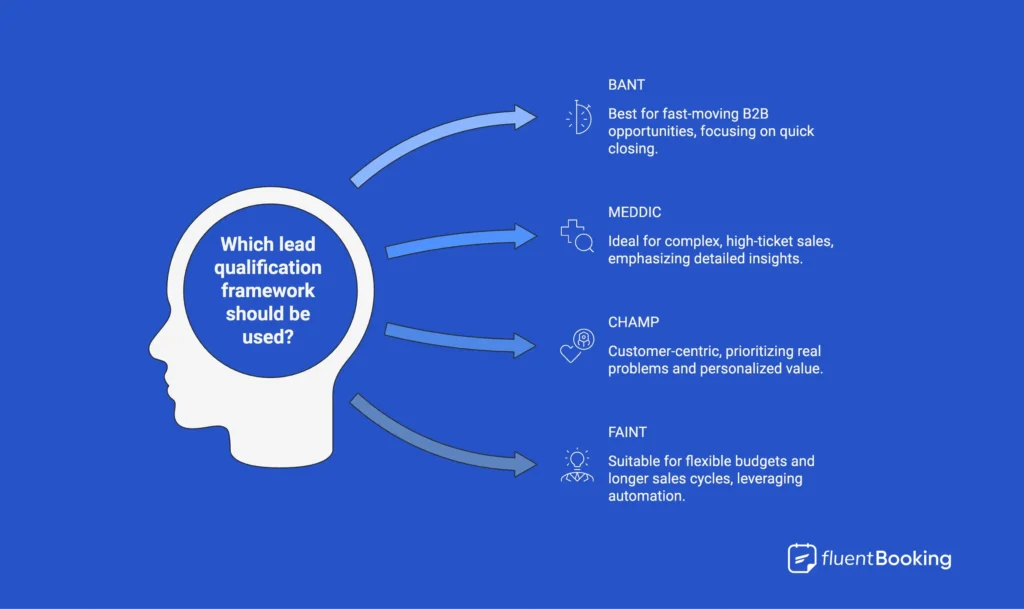
Choosing the right framework gives your team a structured approach to evaluate leads efficiently. Here are four widely used frameworks:
BANT – Budget, Authority, Need, Timeline
BANT is one of the oldest and most widely used sales qualification frameworks, designed to help sales teams quickly determine whether a lead is worth pursuing. It evaluates four critical factors:
- Budget: Does the lead have the financial resources to buy?
- Authority: Is the contact a decision-maker or influencer?
- Need: Does the lead have a clear problem your solution solves?
- Timeline: Is there a reasonable timeframe for purchase?
The framework is particularly effective for B2B teams that want to focus on fast-moving opportunities. By assessing these four criteria, you can prioritize leads with the highest potential, disqualify low-fit prospects early, and shorten your sales cycle.
BANT works best when you want to avoid long-term nurturing of unqualified leads, although it can sometimes overlook prospects who might become valuable long-term customers.
Why it matters: BANT provides a quick, structured approach to separate leads who can close soon from those who may waste your team’s time. It’s seller-focused but reliable, making it ideal for teams that need clarity and speed in their qualification process.
Limitations:
- May oversimplify the qualification
- Risks of prematurely disqualifying long-term potential leads
- Focuses on seller priorities, not always the customer’s context
MEDDIC – Metrics, Economic Buyer, Decision Criteria, Decision Process, Identify Pain, Champion
MEDDIC is a comprehensive, high-value sales framework that focuses on understanding the lead’s business metrics, decision-making process, and key pain points. Unlike simpler frameworks, MEDDIC evaluates not just whether a lead is interested, but whether your solution aligns with their strategic goals and KPIs.
The six components are:
- Metrics: Quantifiable outcomes the lead wants to achieve
- Economic Buyer: Who controls the budget
- Decision Criteria: What factors influence the purchase
- Decision Process: The steps the organization follows to decide
- Identify Pain: The critical problems your solution addresses
- Champion: Internal advocate who supports your solution
Why it matters: MEDDIC is ideal for complex, high-ticket B2B or SaaS sales, where multiple stakeholders and long decision cycles make qualification difficult. It ensures that sales teams collect actionable insights, avoid wasted effort, and focus on leads most likely to convert. This framework is more detailed than BANT and helps sales teams navigate sophisticated buying environments with confidence.
Limitations:
- Complex and time-consuming
- Requires strong CRM discipline and organized data
- Not ideal for fast-moving or transactional sales
CHAMP – Challenges, Authority, Money, Priority
CHAMP is a customer-centric framework that flips traditional qualification on its head: it starts by understanding the lead’s challenges before asking about budget or authority. The framework evaluates:
- Challenges: Identify the lead’s most pressing problems
- Authority: Confirm decision-making power
- Money: Budget or willingness to invest
- Priority: How urgent is this challenge relative to other initiatives
Why it matters: CHAMP emphasizes solving real customer problems, making it highly effective for teams who want to personalize their sales approach and demonstrate value early. It accelerates the qualification process and helps sales reps focus on leads with the most urgent pain points, even when budget or timelines aren’t perfectly defined. However, its simplicity means it may overlook detailed decision-making processes.
Limitations:
- May overlook detailed decision-making processes or timelines
- Simplicity may not suit complex sales cycles
- Less structured for scoring leads quantitatively
FAINT – Funds, Authority, Interest, Need, Timeline
FAINT is a modern framework designed for leads with flexible or unplanned purchase potential. Unlike BANT, which focuses strictly on budget, FAINT evaluates available funds, authority, genuine interest, need for your solution, and an actionable timeline.
Why it matters: This framework is particularly useful for longer B2B sales cycles or markets where leads don’t have predefined budgets, allowing your team to identify high-potential opportunities faster. FAINT works well with automation and CRM-based lead scoring, making it ideal for teams handling large volumes of leads while still qualifying intelligently.
Limitations:
- May focus on funds over actual interest or fit
- Could overlook smaller leads who are otherwise a good match
- Not ideal for a strict budget-driven qualification
Choosing the right lead qualification framework is crucial to boost efficiency, improve pipeline accuracy, and increase conversion rates. The expanded definitions above help your sales team understand why each framework exists, the specific problems it solves, and when to use it, making your process smarter and more actionable than competitors’ guides.
The 7-Step Process to Identify and Qualify Sales Leads
While automation tools can help, relying entirely on them may cost you deals and opportunities. The key is to create a repeatable, partially automated process that your sales team can implement to qualify leads and boost conversion rates accurately.
Here’s a step-by-step roadmap to help you do just that:
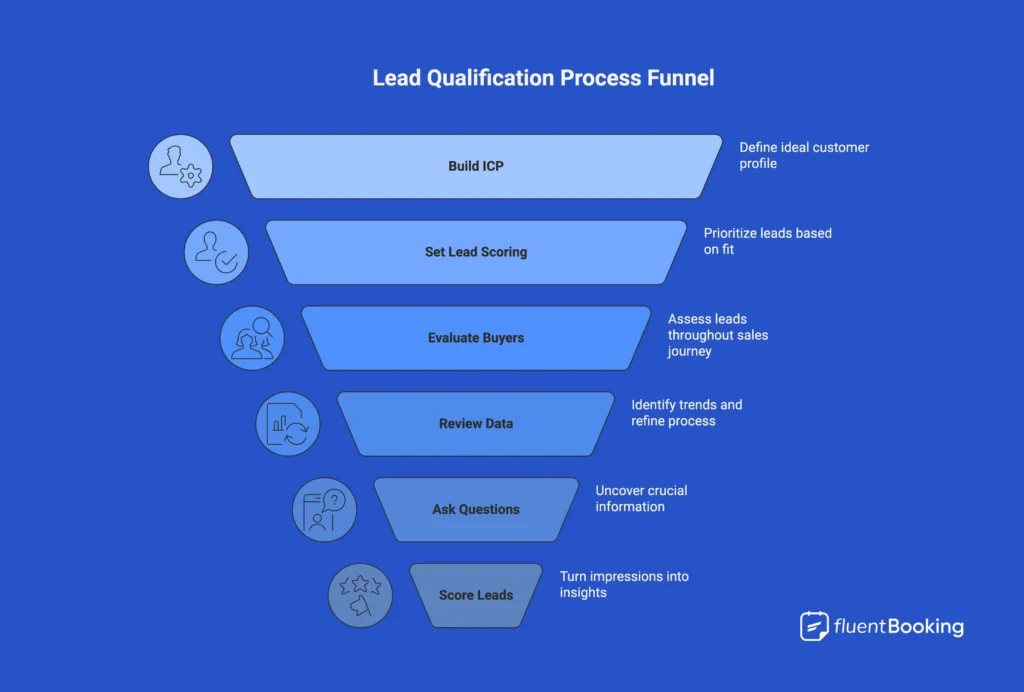
Step 1: Build Your Ideal Customer Profile (ICP)
Before you can qualify leads, define exactly who benefits most from your product or service. This profile will guide all future lead evaluation.
Key elements to include:
- Company size & type: Startup, SME, or enterprise?
- Industry & niche: Which verticals gain the most value?
- Revenue & cash flow: Can they afford your solution?
- Pain points & challenges: What problems do they need solved?
- Employee structure & decision-makers: Who will use or approve your solution?
- Goals & priorities: What outcomes matter most to them?
Pro tip: Involve stakeholders across marketing, sales, and customer success when building your ICP. The more detail you include, the easier it becomes to qualify leads consistently and predict which prospects will be high-value customers.
Step 2: Set Up a Lead Scoring System
Once your ICP is clear, create a lead scoring system to prioritize prospects based on fit and engagement. Lead scoring ensures your sales team focuses on the best opportunities first.
Two common approaches:
1. Predictive Lead Scoring
- Uses data analytics to estimate which leads are most likely to convert.
- Leverages historical patterns from past buyers and your CRM data.
- Works best if you have detailed ICP data and a CRM with AI or analytics capabilities.
2. Rule-Based Lead Scoring
- Assigns points or grades to leads based on pre-defined ICP criteria.
- Examples: “Company size > 50 employees = 5 points” or “Decision-maker engaged = Yes/No.”
- Define a minimum score threshold to consider a lead qualified.
- Use checklists or scorecards to keep evaluations consistent across the team.
Pro tip: Combine scoring with automation where possible. For instance, use forms or CRM integrations to automatically calculate lead scores based on submissions, behaviors, or engagement.
Step 3: Evaluate Your Buyers at Every Stage
Once your ICP and lead scoring system are in place, it’s time to evaluate each buyer throughout the sales journey.
- During every sales call or demo: Assess the lead against your scoring criteria and qualification framework.
- Early-stage evaluation: Consider building rubrics for leads in the awareness or consideration stage. This allows marketing and sales to identify high-potential leads sooner.
- Self-qualification tools: Tools like automated demos or interactive product tours let buyers explore your solution on their own. Leads who engage heavily here often indicate a strong interest before even booking a call.
Pro tip: Treat every interaction as a data point. The more you observe and score leads early, the better your sales team can prioritize high-potential opportunities.
Step 4: Review and Refine Your Lead Data
Lead qualification is never “set and forget.” To maximize accuracy and efficiency:
- Regularly revisit your lead data: Do this monthly or quarterly to identify trends and refine your qualification process.
- Adjust scoring criteria as needed: Markets change, ICPs evolve, and lead behavior shifts. Update your rubric or thresholds to match the current reality.
- Improve pipeline accuracy: Refining your process helps your team focus on leads most likely to convert, reducing wasted time and increasing overall sales efficiency.
Pro tip: Use FluentCRManalytics and segmentation features to track engagement, lead-to-customer conversion rates, and recurring objections. This helps your team continuously refine your lead qualification process.
Step 5: Ask the Right Qualification Questions
Asking the right questions separates serious leads from casual browsers. Use your ICP and lead scoring framework as a guide to uncover crucial information:
- Pain points: “What challenges are you currently facing in [area]?”
- Decision-making authority: “Who else is involved in making this decision?”
- Budget and timeline: “Do you have a budget allocated for this project?” / “When do you plan to implement a solution?”
- Previous solutions: “Have you tried other tools or services before? What worked or didn’t?”
Pro tip: Keep conversations friendly, not interrogative. Discovery calls should be structured but casual, giving leads a chance to share openly while your team gathers essential insights.
Step 6: Score Leads Effectively
Lead scoring turns subjective impressions into objective insights, helping your team prioritize the most promising prospects.
- Rule-based scoring: Assign points for each lead based on how well they match your ICP criteria (e.g., budget, company size, engagement level).
- Predictive scoring: Use analytics or AI tools in your CRM to automatically predict which leads are most likely to convert.
- Behavioral signals: Track website visits, content downloads, demo requests, and engagement with emails or campaigns.
- Prioritization: Categorize leads into high, medium, and low priority, and assign them to the right sales reps or workflows.
Pro tip: Look for green flags like leads who can articulate their pain clearly or decision-makers who respond promptly; they’re more likely to convert quickly.
Step 7: Review, Refine, and Re-qualify Leads
The best lead qualification processes are continuous, iterative, and data-driven.
- Regular reviews: Assess lead quality monthly or quarterly to identify trends, bottlenecks, and opportunities for improvement.
- Refine your scoring and questions: Update thresholds, add new qualifying questions, or tweak your ICP as your market and product evolve.
- Re-qualify leads: Some leads may become sales-ready later; others may no longer fit your ICP. Keep your funnel clean by recycling, nurturing, or disqualifying leads accordingly.
- Measure KPIs: Track MQL-to-SQL conversion rates, pipeline velocity, and customer acquisition costs (CAC) to ensure your process is driving results.
Pro tip: A well-reviewed, refined lead qualification process helps your sales team focus on high-value opportunities, shortens the sales cycle, and increases overall conversion rates.
Lead Qualification Checklist: What to Review Before Moving a Lead Forward
Before moving a lead forward, your team should evaluate signals across four key areas: Interest, Fit, Intent, and Sales Context. This ensures you’re qualifying based on complete insight, not isolated data points.
1. Interest Signals: Are They Exploring Seriously?
These signals show how actively a prospect is researching your solution.
What to review:
- Website pages visited, frequency, and browsing sequence
- Content downloads, document views, and interactions with high-intent conversion elements such as an sms popup
Why it matters: You can identify what topics resonate most, how deeply they’re evaluating options, and whether their behavior suggests casual browsing or serious consideration. This helps time outreach correctly and tailor follow-ups based on real engagement patterns.
2. Fit Signals: Do They Match Your Ideal Customer Profile?
Interest alone isn’t enough; the lead must align with your ICP.
What to review:
- Job title, role, and decision-making authority
- Company size, industry, and growth stage
Why it matters: This prevents your team from investing time in poor-fit prospects. Confirming role relevance and company alignment ensures you focus on buyers who are more likely to convert, renew, and expand long-term.
3. Intent Signals: Are They Moving Toward Action?
Intent signals show whether a lead is transitioning from research to serious buying consideration.
What to review:
- Product usage behaviors (logins, feature activations, repeat sessions)
- Source of acquisition (campaign, channel, or outbound motion)
Why it matters: Active product engagement suggests stronger buying intent than passive interest. Similarly, leads from high-intent campaigns often require faster and more personalized follow-up.
4. Source of Acquisition: Where Did They Come From?
Identify which campaign, channel, or touchpoint brought the lead in.
What to review:
- Original traffic source (paid campaign, organic search, referral, outbound, event, etc.)
- Campaign messaging that drove the interaction
Why it matters: Understanding the source of acquisition helps you determine whether the lead came from a high-intent channel or a lower-intent touchpoint. It also reveals which message, offer, or campaign initially captured their attention. With this insight, your team can tailor follow-ups to match the lead’s original interest and buying intent.
Leads from targeted campaigns or outbound motions often require faster, more personalized outreach.
5. Sales Context: What Has Already Happened?
Qualification doesn’t happen in isolation; context matters.
What to review:
- Outreach history (calls, emails, meetings, responses)
- Previous messaging attempts and engagement outcomes
Why it matters: This prevents duplicated efforts, avoids irrelevant follow-ups, and ensures continuity across the sales team. Understanding past interactions helps reps move conversations forward rather than restarting them.
Better Qualification, Bigger Wins
Lead qualification isn’t just a sales task; it’s a growth strategy. When your team consistently evaluates fit, engagement, intent, acquisition source, and sales context, you stop chasing noise and start focusing on real opportunities.
A structured qualification process reduces wasted effort, shortens sales cycles, and improves conversion rates. It ensures marketing attracts the right prospects, sales prioritizes the right conversations, and leadership gains a more predictable pipeline.
Build the habit of reviewing, refining, and aligning your qualification criteria regularly, because the better you qualify leads, the faster you close deals and drive sustainable revenue.
Frequently Asked Questions
Ratul Ripon
I enjoy making complex ideas simple and engaging through my writing and designs. With a strong knowledge on content writing and SEO, I create technical content that’s both easy to understand and interesting.
Table of Content
Subscribe To Get
WordPress Guides, Tips, and Tutorials


Leave a Reply