

How AI Agents Can Simplify Appointment Management


Managing appointments doesn’t end when someone books a time. As a host, you still need to track meetings, adjust schedules, check availability, and handle booking changes throughout the day.
For busy businesses, these routine tasks can add up. You may need to move between your booking system, calendar, and other tools just to handle simple requests.
AI agents offer a different way to manage these tasks. Instead of navigating through multiple screens, you can describe what you need in plain language and let an AI agent work with the connected tools.
In this guide, we’ll look at how AI agents can simplify appointment management, where they can help, and what this means for businesses that rely on online scheduling.
Where Appointment Management Gets Time-Consuming
For a host, managing appointments often means dealing with many small tasks throughout the day. None of them may seem difficult on their own, but together they can take up a significant amount of time.
Switching Between Different Tools
Your booking information may live in one system while your calendar, customer information, and other business tools are somewhere else. Finding the right information can mean moving between different screens and applications.
Finding the Right Information
A simple question like “What does my schedule look like tomorrow?” may require opening your booking dashboard, checking your calendar, and going through multiple appointments.
Handling Schedule Changes
Appointments don’t always stay as originally planned. Customers may need to change their time, meetings may need to be moved, or your own availability may change. Handling these updates manually adds another layer of administrative work.
Repeating Routine Tasks
The same scheduling actions often happen again and again: checking availability, looking up bookings, updating schedules, and reviewing booking activity.
The challenge isn’t that these tasks are particularly complicated. It’s that you have to repeat them so often. This is where AI agents can provide a different way to interact with your appointment management system.
Why Use AI for Appointment Management?
AI-assisted appointment management can make everyday scheduling work simpler, especially for businesses that handle a large number of appointments or frequent schedule changes.
Spend Less Time on Routine Tasks
Checking calendars, looking up bookings, and making simple scheduling updates can take time when you have to handle each task manually. An AI agent can help with supported routine tasks through simple instructions.
Get Information Faster
Instead of searching through different sections of a booking system, you can ask for the information you need directly. This can make it easier to get a quick overview of your schedule or booking activity.
Reduce Unnecessary Dashboard Navigation
Many scheduling tasks involve several clicks and screens. An AI-powered workflow can reduce those steps by letting you start with your goal rather than figuring out where to find the right setting.
Handle Scheduling Changes More Easily
Appointments often change after they’re booked. When the necessary tools and permissions are available, an AI agent can help manage supported changes without requiring you to manually work through the entire process.
Focus More on the Work That Matters
The goal isn’t to automate every decision or remove the need for a booking system. It’s to reduce the amount of repetitive administrative work involved in managing appointments, giving hosts more time to focus on their customers and business.
How AI Changes the Appointment Management Workflow
The biggest change AI brings to appointment management is not simply adding more features. It changes how you interact with those features.
In a traditional workflow, you usually need to know where to go in your booking system and which steps to follow. Even a simple request can involve moving through several screens.
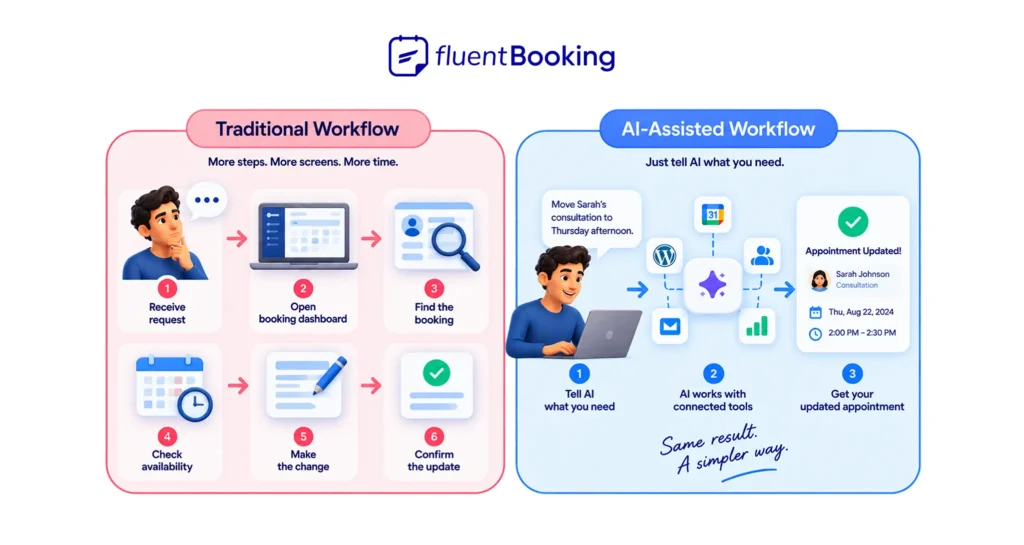
Traditional Appointment Management
A typical workflow might look like this:
Open dashboard → Find the right section → Search for the appointment → Check availability → Make the change → Save
This works, but you have to navigate the system yourself and know where each action is located.
AI-Assisted Appointment Management
With an AI-assisted workflow, you start with what you want to accomplish instead of where you need to go.
Describe what you need → AI interprets the request → Uses the appropriate connected tools → Returns the result or takes the permitted action
For example, instead of opening your booking dashboard and looking for a specific appointment, you could tell your AI assistant:
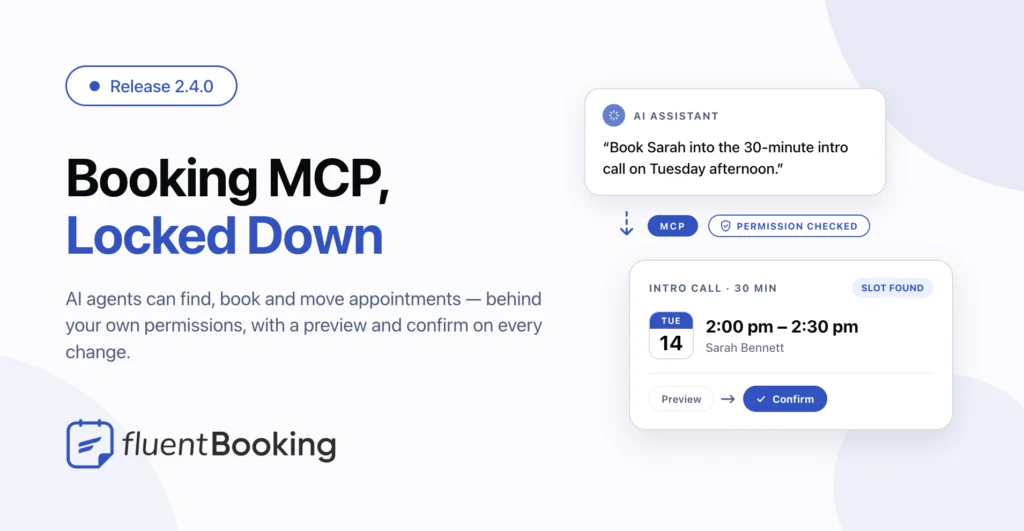
“Move Sarah’s consultation from Wednesday to Thursday afternoon.”
The AI can then work with the connected appointment tools to handle the request according to the access and actions available to it.
The difference is simple: you focus on the outcome, while the AI handles the steps needed to get there.
This does not replace your booking system. Your booking system remains the source of truth for appointments, schedules, and availability. AI simply provides another way for hosts and teams to interact with those functions.
Who Can Benefit From AI-Assisted Appointment Management?
AI-assisted appointment management can be useful for any business where hosts regularly spend time managing schedules, bookings, and availability. The impact can be especially noticeable when appointments are frequent or multiple people are involved in managing them.
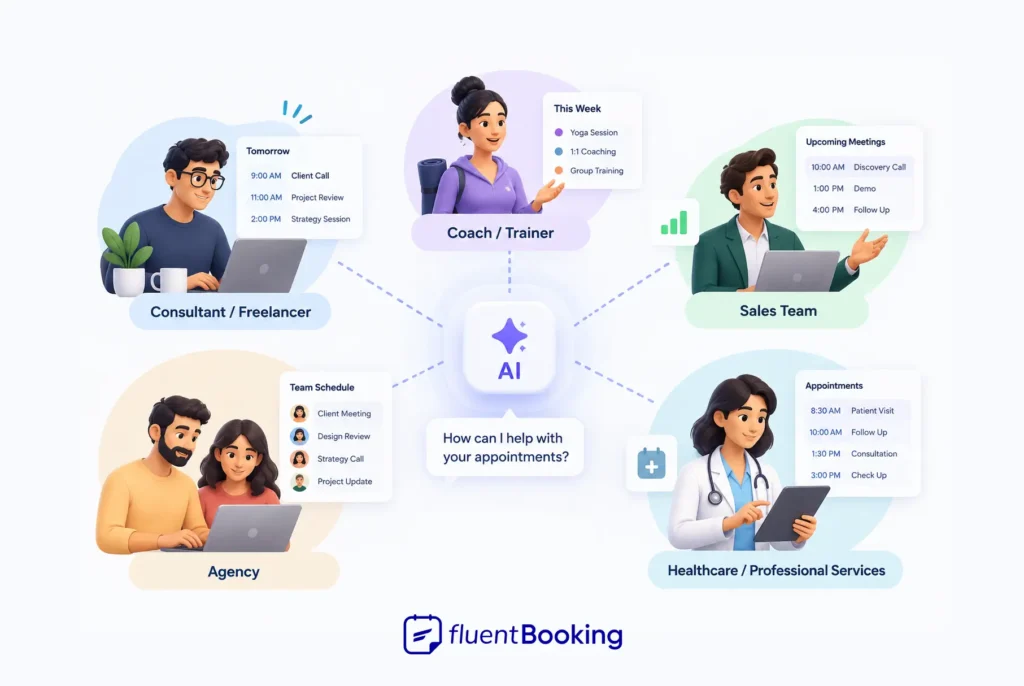
Consultants and Freelancers
Consultants often manage their own schedules while also handling client work. An AI-assisted workflow can make it easier to keep track of meetings and handle routine scheduling tasks without constantly switching between work and booking tools.
Coaches and Trainers
Coaches and trainers may manage multiple sessions throughout the week. Using an AI agent can provide a quicker way to stay on top of their schedules and handle routine changes as their availability shifts.
Sales Teams
Sales teams often coordinate meetings with prospects and manage schedules across multiple team members. An AI-assisted workflow can help reduce the manual work involved in keeping sales calendars organized.
Agencies
Agencies may manage appointments for different clients, services, or team members. An AI agent can provide a more conversational way for authorized users to work with their scheduling systems instead of navigating through different dashboards for every task.
Healthcare and Professional Service Teams
Teams that rely heavily on appointments often have busy schedules and frequent changes. AI-assisted management can help authorized staff handle routine scheduling work while keeping the underlying booking system in place.
Businesses With Multiple Hosts or Event Types
As a business grows, managing different hosts, services, and event types can become more complicated. An AI-assisted workflow can make it easier for authorized users to interact with scheduling information without manually searching through every part of the system.
The common thread across these businesses is simple: the more scheduling work a team handles, the more valuable a simpler way to interact with that system can become.
What Makes AI-Assisted Appointment Management Possible?
An AI agent can’t manage an appointment system on its own. It needs access to the right software, tools, and permissions.
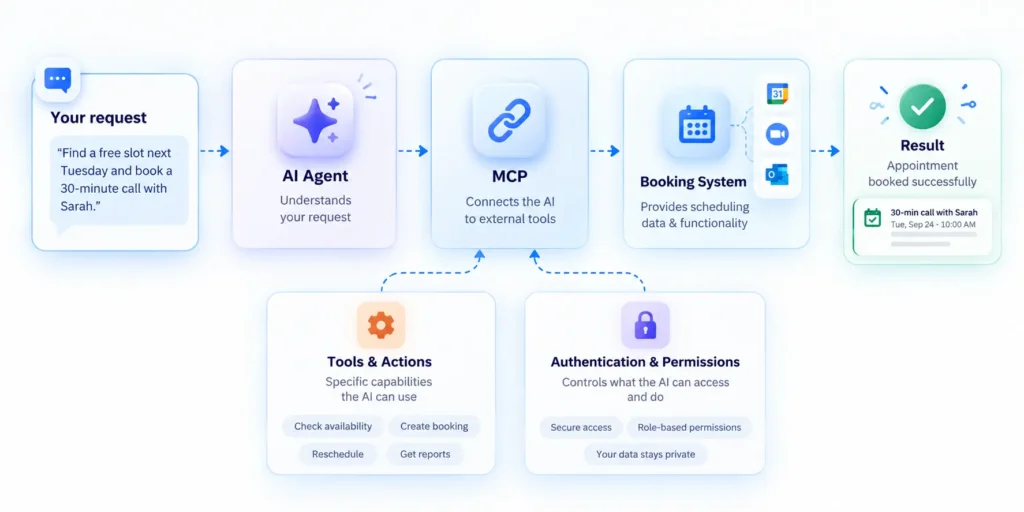
A typical AI-assisted scheduling workflow brings together a few key pieces:
- An AI agent: Understands what the host wants to accomplish.
- Connected business software: Provides the actual scheduling data and functionality.
- Tools and actions: Give the AI specific capabilities it can use.
- Authentication and permissions: Control which information and actions are available.
- A connection protocol such as MCP: Provides a standardized way for the AI application to communicate with the available tools.
When these pieces work together, an AI agent can move beyond simply answering questions and interact with the scheduling system in a controlled way.
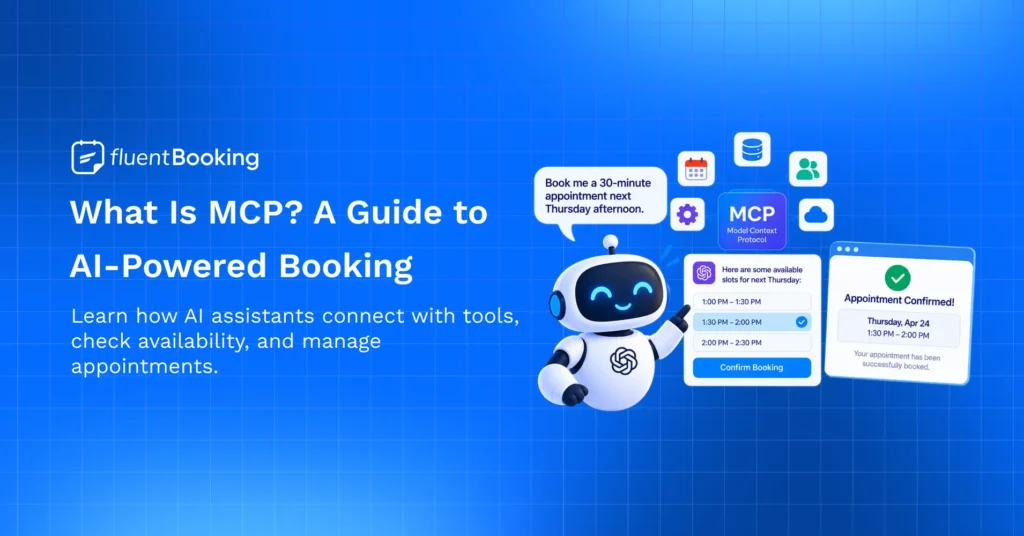
Bonus: If you want to understand how this connection works in more detail, see our guide on what MCP is and how it connects AI applications with external tools.
AI-Assisted Appointment Management in WordPress
WordPress powers many websites that rely on plugins for everyday business functions, including appointment scheduling. As AI agents become better at working with connected tools, these plugins can provide another way for site owners and administrators to manage their workflows.
For example, a WordPress booking plugin can expose supported scheduling tools to an AI agent. An authorized host could then use natural-language instructions to work with information and actions that the plugin makes available.
For example: FluentBooking, an appointment booking plugin. Its MCP server allows compatible AI clients to interact with supported FluentBooking functionality, giving hosts another way to work with their booking system.
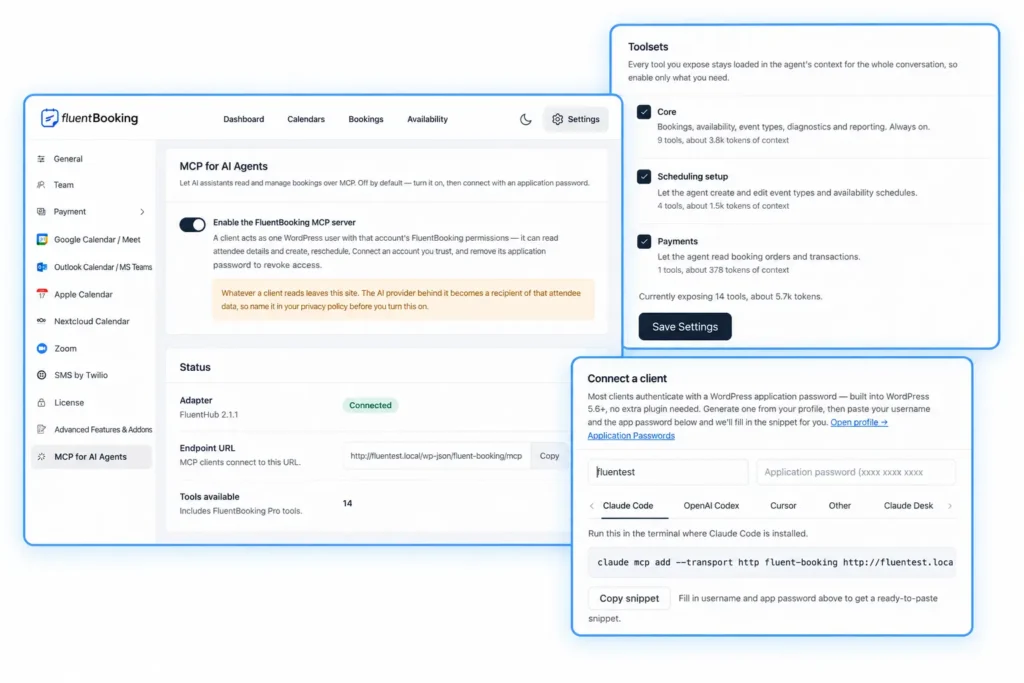
The important point is that AI does not replace the booking system. FluentBooking remains the place where the underlying appointments, availability, and scheduling information are managed. AI simply provides another interface for working with those functions.
This shows how AI agents can fit into an existing WordPress workflow without requiring businesses to replace the tools they already use.
The Future of Appointment Management
Appointment management is gradually moving toward more conversational ways of interacting with business software. Instead of thinking about which screen or setting to open, users can increasingly start with what they want to accomplish.
This shift could make several parts of appointment management simpler.
From Interface-First to Intent-First
Traditional software asks you to navigate an interface to complete a task. AI-assisted workflows start with your intent. You describe what you want, and the AI works with the available tools to help accomplish it.
More Business Software Accessible Through AI
As more software exposes its functionality to AI agents, scheduling systems may become part of a larger network of connected business tools. An AI agent could work across the systems a business already uses, depending on the available integrations and permissions.
More Conversational Administrative Work
Routine tasks don’t always require complex decision-making. As AI agents become better at working with connected tools, more administrative work could be handled through simple conversational instructions.
Appointment Management as Part of a Larger Workflow
Scheduling rarely happens in isolation. It can connect with sales, customer management, communication, and other business processes. AI agents could eventually help businesses manage these connected workflows through a more unified, conversational experience.
The goal isn’t to eliminate the software businesses already rely on. It’s to make that software easier to interact with and more accessible through natural language.
A Simpler Way to Manage Appointments
Managing appointments involves many routine tasks, and AI agents can make some of them easier to handle. Instead of manually navigating your booking system for every request, you can describe what you need and let the AI work with the tools and permissions available to it.
The booking system still remains the source of truth for your schedules, availability, and appointments. AI simply gives hosts another way to interact with those functions.
As AI agents become more connected to business software, appointment management can become less about finding the right screen and more about telling your tools what you need.
Ratul Hasan Ripon
I enjoy making complex ideas simple and engaging through my writing and designs. With a strong knowledge on content writing and SEO, I create technical content that’s both easy to understand and interesting.
Table of Content
Subscribe To Get
WordPress Guides, Tips, and Tutorials


Leave a Reply